Why Taint Analysis Matters in Modern AppSec — and How We Use It in VulnReach
Modern application security tools produce thousands of findings, yet security engineers constantly struggle with a fundamental question: Is this vulnerability actually exploitable?
Traditional scanners excel at detecting patterns, but they rarely answer the most important question: Can attacker-controlled input actually reach the vulnerable code? This is where Taint Analysis becomes critical.
The Problem with Traditional Security Scanners
Most AppSec tooling today falls into three distinct categories, each with a specific "blind spot":
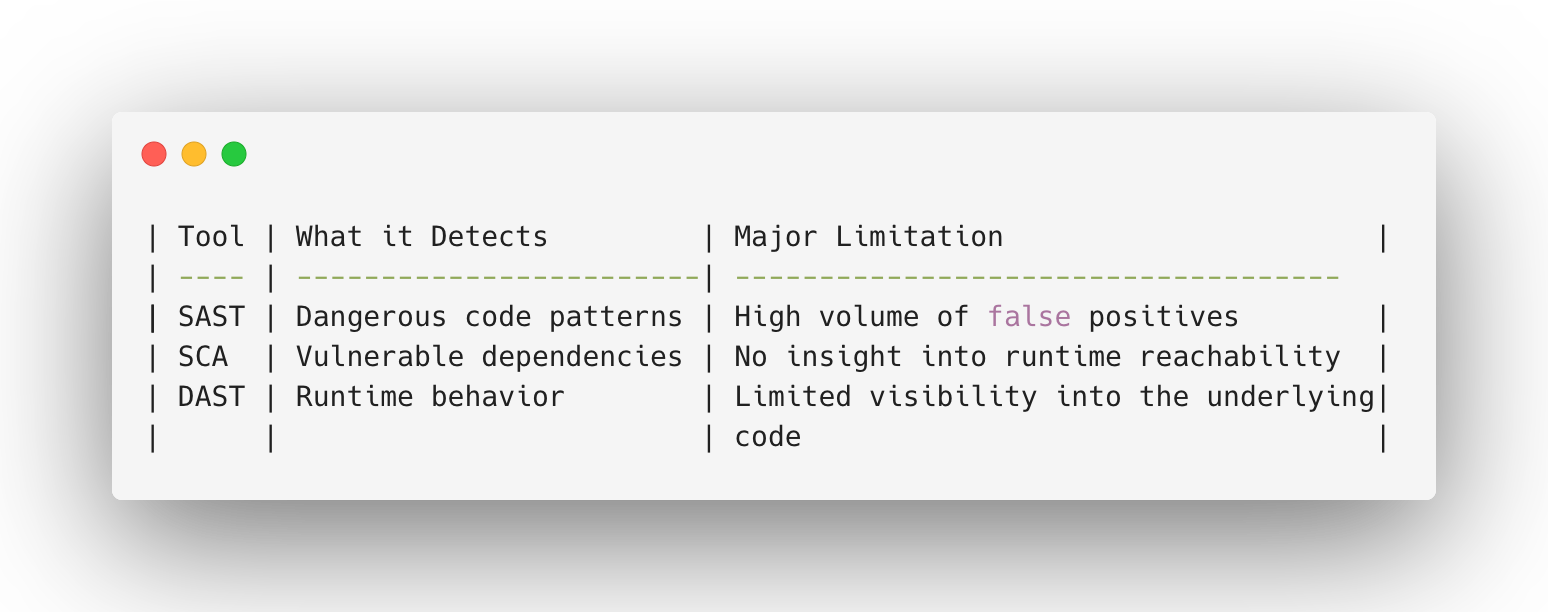
The Reachability Gap
Traditional scanners lead to alert fatigue because they cannot differentiate between a theoretical bug and a real attack path. Without understanding data flow, a tool might flag a vulnerability in a library that is included in your project but never actually called by your execution logic.

What is Taint Analysis?
Taint analysis tracks how untrusted input propagates through an application. The concept follows a simple three-step logic:
- Sources: Mark attacker-controlled inputs (HTTP params, headers, etc.) as "tainted."
- Propagation: Track how that tainted data moves through variables and functions.
- Sinks: Check if that tainted data eventually hits a sensitive operation (SQL execution, OS command, etc.).
Common Sources and Dangerous Sinks
| Category | Examples | Potential Vulnerability |
|---|---|---|
| Sources | HTTP params, Form inputs, API responses | Entry points for untrusted data |
| Sinks | db.execute(), os.system(), eval() | SQLi, Command Injection, XSS |
Static vs. Dynamic Taint Analysis
There are two primary approaches to tracking data flow, each with its own trade-offs:
1. Static Taint Analysis
Evaluates the source code without executing the program.
- Pros: Fast, scalable, and easy to integrate into CI/CD pipelines.
- Cons: May overestimate data flows (false positives) as it cannot always resolve dynamic runtime behavior.
2. Dynamic Taint Analysis
Tracks data flow during program execution.
- Pros: Extremely accurate; captures real runtime paths.
- Cons: Requires instrumentation and performance overhead; limited by the code coverage of your tests.
VulnReach aims to bridge this gap by correlating static reachability analysis with evidence-based data flow.
Real-World Example: Tracking the Flow
Consider a web application with the following endpoint:
@app.route("/run")
def run():
    cmd = request.args.get("cmd") # Source
    execute(cmd)

def execute(command):
    # This represents a command injection vulnerability
    subprocess.run(command, shell=True) # Sink
A taint analysis engine detects this flow:
HTTP Request → request.args["cmd"] → execute() → subprocess.run()
The result is a confirmed reachable vulnerability. The security engineer doesn't just see a bug; they see the entry point, the internal path, and the final destination.
Understanding how a vulnerability is reached naturally leads to the next question: if we can trace reachable paths, how many reported vulnerabilities have no reachable path at all?
Why Most Vulnerabilities Are Not Exploitable
This is a hard truth in AppSec: many reported issues pose zero real-world risk.
- The vulnerable function is in the library but never called.
- The code path is behind a specific configuration or authentication layer.
- The vulnerability requires conditions the application never satisfies.
These are ghost risks — vulnerabilities that exist in theory but have no viable path to exploitation. If an application uses safe_function() from a library but ignores vulnerable_function(), a standard SCA tool will still flag a CVE. The result: hundreds of engineering hours burned chasing ghost risks instead of real threats.
Why Developers Ignore Security Tools
One of the biggest challenges in AppSec is developer trust. When tools provide hundreds of warnings without context, developers see them as noise.
- The Problem: Too many false positives and a lack of exploitability info.
- The Solution: Providing full exploit paths.
Reducing noise is often more valuable than detecting more vulnerabilities. When a developer can see exactly how a user input reaches a sink, they fix it immediately.
The Vision Behind VulnReach
VulnReach was built to move beyond simple detection. Security tools should not only find problems—they should explain how they can be triggered.
By combining SBOM analysis, dependency scanning, and taint tracking, VulnReach helps teams answer the ultimate question:
Is this vulnerability actually reachable from attacker-controlled input?
In practice, this means VulnReach works in three stages. First, it builds a precise SBOM to map every dependency in scope. Second, it cross-references those dependencies against known CVEs. Third — and this is what separates it from standard SCA tools — it performs reachability analysis to confirm whether the vulnerable function is actually callable from an attacker-controlled entry point. A finding only surfaces if all three signals align. No ghost risks, no alert fatigue — just confirmed, exploitable vulnerabilities with a full attack path attached.
Final Thoughts
Traditional scanners are excellent at finding problems, but modern AppSec requires tools that can prove exploitability. By integrating taint analysis with reachability mapping, we move one step closer to a noise-free security pipeline.
Stay tuned for more updates on the VulnReach project!